
Supergoop! DTC Brand Breakdown: How a Teacher Turned Sunscreen Education into a $700M Empire
Updated: May 11

In 2007, Holly Thaggard was a schoolteacher in San Antonio with no beauty industry experience, no investors, and a maxed-out credit card. What she did have was a painful catalyst: a close friend had just been diagnosed with skin cancer. That personal shock became the founding premise of Supergoop!, a brand built on a deceptively simple idea, that wearing sunscreen should be as automatic as brushing your teeth.
Nearly two decades later, Supergoop! has become one of the most consequential DTC beauty brands in America. The company reached $250 million in annual sales in 2022, a 65% year-over-year surge, and attracted a majority investment from Blackstone at a $600 to $700 million valuation. But this trajectory was anything but linear. Supergoop!'s story is one of radical pivots, from school hallways to Sephora shelves, from a single SKU to 40+ products, and from bootstrapped survival to private equity-backed global expansion.
WHO: The Supergoop! Consumer, from Anxious Moms to Skincare-Obsessed Gen Z
Supergoop!'s earliest customers were not beauty shoppers at all. They were parents. Thaggard's first distribution model was pairing sunscreen samples with a sun-safety curriculum she personally delivered to private schools across Texas. The initial audience was health-conscious mothers who understood the medical case for daily SPF but found existing products greasy, chalky, and unpleasant for their children.
That narrow audience expanded dramatically when the brand entered Sephora in 2011. The retail partnership repositioned Supergoop! from a "wellness" product into a beauty essential, attracting millennials who were beginning to embrace skincare as self-care. By 2020, the brand's DTC business alone doubled in size as pandemic-era consumers, stuck at home but increasingly invested in skin health, discovered Supergoop! through social media.

Today, Supergoop! describes its target as spanning "from makeup-loving millennials to Gen Z skincare enthusiasts, wellness-minded men to six-month-old babies." That breadth sounds like marketing speak, but it reflects a genuine evolution. The brand's Unseen Sunscreen, with its invisible, primer-like texture, became a cult favorite among beauty enthusiasts, while the PLAY line serves families and active consumers. Unlike brands that chase trends, Supergoop! grew its audience by solving a universal problem with format-specific solutions for each segment.
WHAT: From One Sunscreen to 40+ SPF-Infused Products
Supergoop!'s product philosophy has always been "SPF in everything." But the path from that principle to a full portfolio was deliberate and slow. The brand launched with a single SPF 50 formula and spent years refining its formulations before expanding.
The breakthrough came with two hero products that redefined what sunscreen could feel like. Unseen Sunscreen SPF 50, a completely transparent, weightless gel, became the brand's signature. It functions as both sun protection and makeup primer, which eliminated the traditional trade-off between SPF and aesthetics. Glowscreen SPF 40, a pearlescent tinted formula, leaned into the "glow" trend, turning sun protection into a highlight step.

By 2023, Supergoop! expanded its SKU count to over 40, up from 30 in 2020, introducing moisturizers, setting powders, lip balms, and even eyeshadows, all with SPF. The Unseen line itself grew into a mini-franchise with body, mineral, and stick variants. Pricing sits in the accessible prestige range ($18 to $48), positioning the brand above drugstore sunscreens but below luxury skincare. This "everyday premium" pricing mirrors the strategy of brands like Glossier, making daily repurchase psychologically easy.
The channel strategy evolved in parallel. Supergoop! started as a school-direct brand, pivoted to specialty retail (Sephora, Nordstrom in 2011), added Ulta Beauty and Amazon for mass accessibility, and eventually opened its own experiential pop-ups. Each channel served a different function: Sephora built prestige credibility, Ulta expanded demographic reach, Amazon captured convenience-driven repurchases, and DTC provided margin and data.
WHY: Education as the Supergoop! Growth Engine
Most beauty brands grow through aspiration. Supergoop! grew through education. The brand's core marketing premise has always been that consumers do not wear enough sunscreen because they do not understand the stakes, and existing products make compliance feel like a chore. Every campaign, from social content to in-store messaging, reinforces this education-first approach.
This strategy initially limited growth, as "teaching people to wear sunscreen" is not a viral proposition. But when social media, particularly TikTok, turned skincare routines into content, Supergoop! was perfectly positioned. The brand's clear, benefit-led messaging translated seamlessly into short-form video. Hashtags like #UnseenSunscreen and #Glowscreen became organic discovery tools, with influencers demonstrating the products' invisible, cosmetically elegant textures.
Beyond social media, Supergoop! invested heavily in experiential marketing. Its "Sunshine Shacks," pop-up installations in cities across the US, increased out-of-home ad spend 22% year over year. The brand also expanded into connected TV and YouTube advertising, recognizing that digital-only marketing had a ceiling. These offline investments gave Supergoop! access to demographics, particularly older consumers, who would never discover the brand on TikTok.
On the retention side, Supergoop!'s SMS marketing proved remarkably effective, with a 167% increase in subscribers year-over-year and an 11.5% conversion rate generating 29x ROI. The high conversion reflects the brand's advantage as a consumable: unlike a lipstick or serum, sunscreen runs out, creating a natural repurchase cycle that DTC channels can capture through timely reminders.
HERSTORY: From $30,000 on a Credit Card to Blackstone's Portfolio
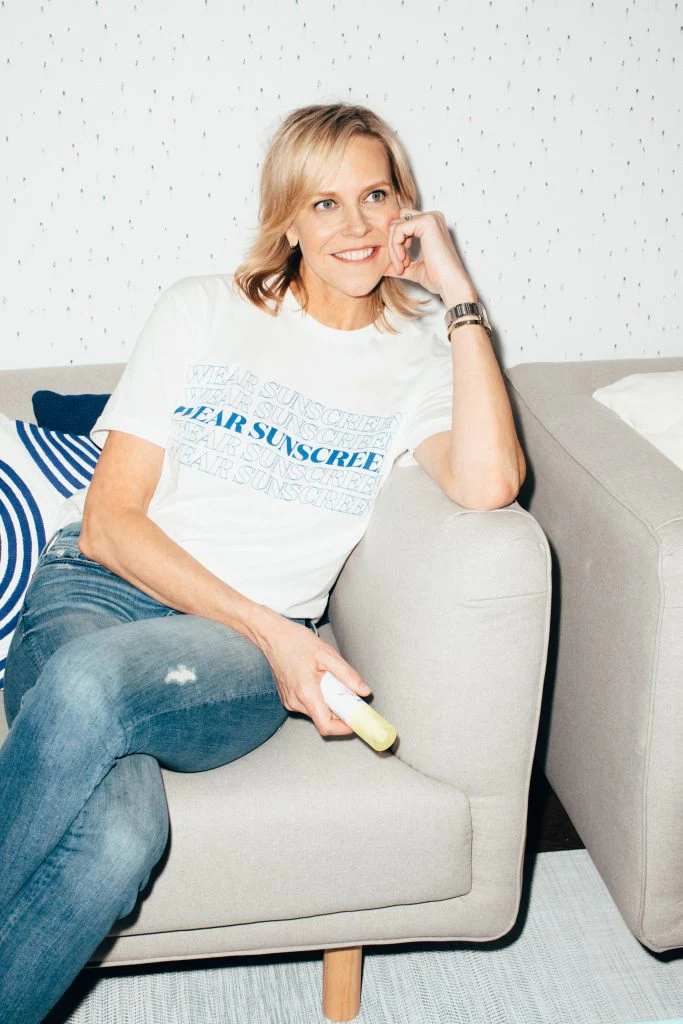
Holly Thaggard's path to building Supergoop! was unconventional by any measure. A harpist and schoolteacher with no connections to the beauty industry, she started the company with $30,000 on a maxed-out American Express card. For years, she personally visited schools, pitched to parent groups, and refined formulas through 15 to 20 iterations before landing on a product she believed in.
The pivot from schools to retail was born of necessity. The education-direct model generated awareness but could not scale. Thaggard began attending trade shows and pitching to kids-focused retailers, eventually landing meetings with Sephora and Nordstrom. The 2011 launch in both chains was a turning point, validating Supergoop! as a beauty brand rather than a health product.
Thaggard bootstrapped the company for over a decade, growing it steadily without venture capital. The pandemic-era surge, which saw approximately $60 million in 2020 sales with the DTC channel doubling, finally attracted institutional attention. In December 2021, Blackstone Growth acquired a majority stake, providing the capital for product expansion and international growth while Thaggard and management retained significant equity.
The post-acquisition period brought leadership transitions. Amanda Baldwin served as CEO before departing to lead Olaplex. Lisa Sequino succeeded her in 2024 but left in mid-2025. In December 2025, Supergoop! appointed Melis del Rey, former GM of Amazon U.S. Health and Beauty, as CEO, signaling a new phase focused on omnichannel scale and global expansion. For a founder-led brand, this level of executive turnover is a challenge, but the brand's identity has proven durable enough to survive leadership changes.
Lessons from the Supergoop! DTC Brand Breakdown
Education creates categories, not just brands. Supergoop! did not enter the sunscreen market. It created the "daily SPF" category by teaching consumers why they needed protection every day, not just at the beach. For Chinese DTC brands entering Western markets, this is instructive: leading with education about an unmet need, whether in skincare ingredients, wellness practices, or product usage occasions, can establish category authority that competitors cannot easily replicate.
Hero products need format innovation, not just formulation. Unseen Sunscreen did not win because it had better UV filters. It won because it felt like a primer, not a sunscreen. This texture-first approach, solving the sensory objections that prevent daily use, is a template for any brand in a category where consumer compliance is the bottleneck.
Bootstrapping builds brand DNA; PE builds scale. Thaggard's 14 years of bootstrapping meant the brand's identity, education-first, ingredient-led, consumer-trusted, was deeply embedded before Blackstone arrived. Brands that take institutional capital too early risk optimizing for growth metrics before establishing the cultural foundation that sustains premium pricing and loyalty.
Omnichannel is not optional for consumables. Sunscreen is used up and repurchased. That makes convenience paramount. Supergoop!'s presence across Sephora, Ulta, Amazon, and DTC ensures that wherever a customer is ready to repurchase, the brand is there. For DTC brands selling consumable products, channel purity is a luxury that limits the repurchase cycle.
Double V Consulting helps international beauty and consumer brands navigate the Chinese market, and supports Chinese brands going global. Whether you are building a DTC channel, entering new retail partnerships, or localizing your brand story, get in touch with our team to explore how we can help.


Comments