
Sephora China After the Joint Venture: What Is a Beauty Retailer For When Douyin Already Picked the Brands?
Key Takeaways
Shanghai Jahwa sold its 19 percent stakes in the two Sephora joint ventures to Sephora Asia for €70 million in August 2026, ending a partnership begun in 2004 and leaving LVMH as sole owner.
Those figures cover two joint-venture companies, not all of Sephora's China operation. On that basis revenue fell from RMB 10.876 billion in 2021 to RMB 7.14 billion in 2024, with a RMB 646 million net loss. Sephora Shanghai then posted a RMB 280,000 net profit in H1 2026.
The model Sephora exported, a discovery retailer that launches niche and exclusive brands, had no job left in China: regulation kept those brands offline until 2021, cross-border channels had already sold them, and discovery moved to Xiaohongshu and Douyin.
Its own attempt to pick winners failed too: a 2022 program that took in eleven premium Chinese brands has mostly emptied out. What works now is stocking traffic brands, the national leaders and Douyin-born labels that arrive with proof.
That looks like what The Colorist and WOW COLOUR did, but the mechanics differ: 26 admissions rather than hundreds, a prestige portfolio on the next wall, and 3,000 advisors running a five-million-member private channel.
A profit of RMB 280,000 is not the kind of number that usually starts an article. On a half-year revenue base of roughly RMB 3 billion it is close to zero. But it is the first time in years that the Shanghai entity behind Sephora China has ended a half on the right side of the line, and it came in the same summer its Chinese partner of 22 years decided to leave. What stopped the bleeding was not a new luxury brand. It was 26 Chinese brands, nearly all of them made popular somewhere else first.
What Did Shanghai Jahwa Actually Sell, and What Do the Numbers Cover?
In August 2026 Shanghai Jahwa announced that it had sold its 19 percent stakes in both Sephora Shanghai and Sephora Beijing to Sephora Asia for €70 million, ending a 22-year partnership. LVMH now owns the China business outright. A scope note matters, because English coverage rounds it off: these are audited results of two companies Jahwa held 19 percent of, the best public window into Sephora's mainland performance but not a consolidated "Sephora China" P&L.
The arc is clear enough. The two entities reported combined revenue of RMB 10.876 billion and net profit of RMB 431 million in 2021, then RMB 7.14 billion of revenue and a RMB 646 million net loss in 2024, an 18.49 percent revenue decline in that year alone. The 2026 half-year filing is where direction changes: Sephora Shanghai turned a RMB 280,000 net profit against a RMB 42.13 million loss a year earlier, while Sephora Beijing narrowed its loss to RMB 52.81 million from RMB 78.09 million. The partner had already written its book value to zero. Selling into a recovery ends a long write-off; it is not a verdict on the next five years.

Why Does Sephora China Now Stock 26 Local Brands It Spent a Decade Without?
To understand the turn, start with the business Sephora runs outside China. There it is a discovery retailer. Its edge is a bench of brands that launch with it or only with it. Fenty Beauty went on sale in 2017 across 1,600 Sephora stores in 17 countries on a single day. Glossier, built on refusing wholesale, chose Sephora as its first retail partner in 2022. And the Clean at Sephora seal, introduced in June 2018, turned an ingredient position into a shelf a shopper could walk to. The chain was not distributing demand, it was making it.
That is the model it carried into China. Three things made it unworkable.
Regulation came first. Until 1 May 2021 imported general cosmetics had to clear animal testing before they could be sold in mainland physical retail, and the exemption that arrived that day still required a manufacturing certificate from the home regulator and a full safety assessment, with children's products, sunscreens and whitening items excluded. Indie labels and clean-positioned newcomers, the brands Sephora's reputation was built on, were exactly the ones that could not absorb that cost. For most of its China run its best inventory was legally unavailable to it.
By the time the door opened, Chinese shoppers had found those brands without it. Cross-border marketplaces, personal shoppers and duty-free Hainan did the importing, and Hainan alone recorded RMB 30.94 billion of offshore duty-free purchases in 2024. A retailer whose value rests on being first cannot be first where the customer already bought the product elsewhere.
Then discovery itself moved. A shelf that exists to make introductions has no job once the introduction happens in a Xiaohongshu post or a Douyin video. This is the structural point we made in Why Beauty Retailers Thrive in the West, but Rarely in China, and Sephora is the clearest case of a Western format hitting it.
Sephora's first response was to keep the role and change the goods: if it could not discover foreign niche brands, it would discover Chinese premium ones. In 2022 it ran an incubation program aimed at five premium domestic brands, including LVMH-owned CHA LING, targeting RMB 100 million in sales within three years. Of the eleven brands the programme took in overall, most have since left the chain. The earlier version was the 2020 launch of Mao Geping Guangyun as a Sephora-exclusive line priced between RMB 180 and RMB 420, a presence Sephora authored rather than recruited. Mao Geping has since listed in Hong Kong and needs no certificate. Picking was never the problem to solve.
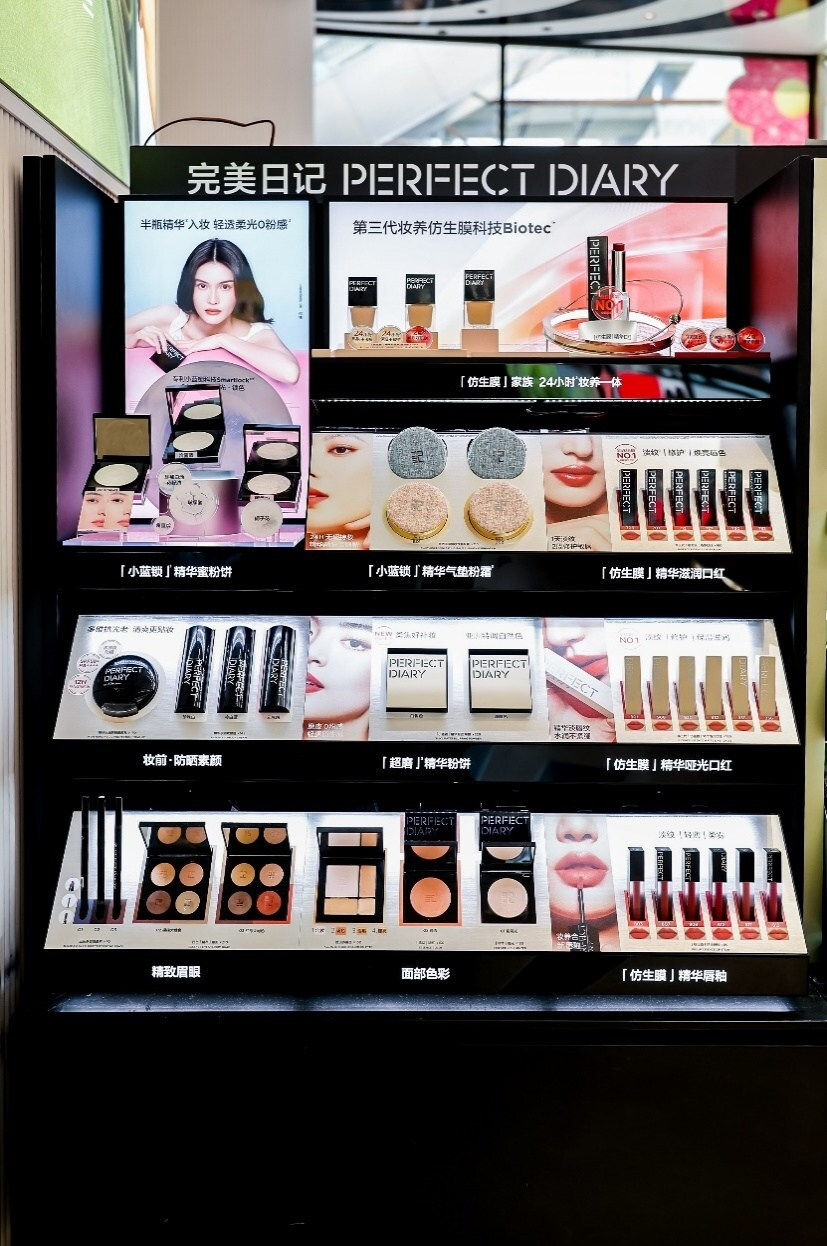
What was left is what we would call traffic brands: the national leaders and Douyin-born labels that walk in with an audience attached. Six arrived in 2025. In April 2026 the chain added eleven more at once, including Florasis, Perfect Diary, Marie Dalgar, Judydoll, Funny Elves and INTO YOU. By July 2026 the count reached 26 Chinese brands across more than 320 stores in 104 cities. Two of them, Judydoll and Joocyee, belong to Joy Group, a portfolio built entirely on Chinese social commerce.
San Zi Tang is the archetype. Its parent company was founded in April 2023, and it did around RMB 840 million on Douyin in 2024, roughly 7.5 times its Tmall sales, crossed RMB 1.5 billion in GMV in 2025 and entered Sephora in November 2025. Short video built the demand; the chain came after. Perfect Diary followed the same order, with parent Yatsen announcing in July 2026 that the brand would enter around 300 Sephora China stores, six years after it became a national name online.
So the buying job has changed. The team no longer stakes its credibility on obscure labels; it reads public performance data and decides which winners deserve a counter. That is closer to a validator than a discoverer, and cheaper. It also costs the retailer the pricing power that came with going first: a brand that sold a million units before it met a buyer does not negotiate from weakness. Proya paying a 595 percent valuation premium for Flower Knows is the same repricing from the capital side.
If Douyin Does the Discovery, What Are 320 Stores Actually For?
Two jobs, and neither is discovery. The first is trust. A brand that broke out on short video carries a specific liability: shoppers suspect the price, the formula and the reviews were engineered. A counter in a prestige chain answers that without a word of copy.
The second is the handover into private traffic. Sephora China runs 3,000 beauty advisors connected to more than five million active members through WeCom, per the same count that put the chain at 320 stores. The store turns a shopper into a named contact both parties can message directly, the part Douyin does not hand over. The chain also reports 21 consecutive months of double-digit footfall growth, with its Xiangyang flagship in Shanghai drawing close to 10,000 visitors since it opened in May.

What Does LVMH's Wider Asia Reshuffle Say About the Bet?
Sephora globally is not the problem. The group reported €8,406 million of Selective Retailing revenue in the first half of 2026, up 5 percent, and confirmed that DFS had sold its Greater China businesses to China Tourism Group Duty Free. Exit travel retail in Greater China, keep and fully own the beauty specialist. Asia has also shown the alternative: Sephora left South Korea by May 2024 after less than five years, beaten by CJ Olive Young, which holds close to 90 percent of the market. Where a local specialist owns discovery and distribution both, an imported prestige format has no distinct job. China came close: at the 2024 low point the chain cut about 3 percent of its roughly 4,000 staff in China, around 120 people, mostly at headquarters. Global CEO Guillaume Motte took direct charge of China in 2025 and, asked which market drives the next phase of growth, answered that the next China is still China. Read as a cost statement rather than a slogan: owning all of a stabilizing chain with 320 leases and five million members is cheaper than rebuilding later.
What Should International Brands Take From the Sephora China Reset?
The obvious objection first. Stocking a wall of Chinese brands is what the domestic beauty collective stores already did, and most of them are gone. The Colorist went from 7 stores in 2019 to 229 in 2020 and 240 by mid-2021, then emptied out of Beijing entirely by mid-2022, while parent KK Group ran more than RMB 7 billion of accumulated losses over three and a half years. The rest of the field went the same way: Sa Sa closed all of its mainland stores in June 2025, Harmay shut its Sanlitun flagship in June 2026 after seven years, HAYDON went from 19 stores to about two, and WOW COLOUR fell from a peak of 300 to less than half that. If the answer to Chinese retail were a shelf of Chinese brands, those companies would have won. So where is the difference?
Three places, and none is assortment. The first is admission. 26 is a small number on purpose: the collective stores competed on breadth, hundreds of labels rotated fast, so a listing signalled nothing. A listing at Sephora is a grade, the rare case in Chinese retail where the shelf is a certification rather than a rack, and that holds only while the admission rate stays low.
The second is what sits on the next wall. A Chinese brand at Sephora is merchandised in the same room as Dior, Lancome and the imported prestige tier, and borrows a little of that adjacency; collective stores never had that portfolio and could not have bought it. The third is the layer after the sale. Their model was self-service, thin margin and exposed to mall rent, with no way to keep a customer after she walked out. Sephora's 3,000 advisors and five-million-member private channel are the opposite bet, and the asset those chains could not assemble.
Beyond those three differences, one more selling point brands hear in meetings should be labelled honestly: getting into Sephora China is said to be an audition for Sephora elsewhere, since one buying organization also runs Southeast Asia, Europe and the Middle East. As of the April 2026 intake that is a promise, not a record, because the rollout is described as strictly China focused, with these brands not yet on Sephora's international shelves. Worth pursuing, not worth pricing in.
For an international brand the reading is three-part. Bring proof rather than a proposal: build verifiable demand on Douyin and Xiaohongshu first, because the buyer reads performance data instead of backing a hunch. Expect to sit beside Chinese brands and expect some to outsell you, which is a reason to compete on category expertise rather than on being foreign. And treat the advisor and private-channel layer as the thing you are actually buying, because a listing buys credibility and a route into member data, not demand. Niche imports have done well in China partly because they understood that, as in Le Labo's China run.
Two things are worth watching: whether Sephora China holds a profit across a full year rather than a single half, and whether the local count climbs past 26. If it keeps climbing, the chain completes its move from prestige gatekeeper to curated department of Chinese beauty, and the certification argument weakens as admission loosens. Either way, the joint venture era of entering China with a local minority partner has one fewer example standing.
Double V is a cross-border operating partner and intelligence house for emerging consumer brands, based in Hong Kong and Shenzhen. We help brands connect China and the world through three businesses: Brand Operation (marketing and distribution for brands on retainer), Brand Incubation (sister company Glam Infinite and our own-built brands), and Industry Intelligence (cross-border research and reports). Talk to our team.


Comments