
From Judydoll to Going Global: Joy Group’s Playbook for Building a Chinese Beauty Powerhouse
For years, China’s emerging beauty brands have often been reduced to a familiar shorthand overseas: fast-moving, price-driven, and heavily reliant on social media traffic. While this description may explain early-stage growth, it no longer captures the full picture of what leading Chinese companies are becoming today.
Joy Group (橘宜集团) is a case in point. Best known as the parent company behind two of China’s most influential color cosmetics brands: Judydoll (橘朵) and Joocyee (酵色). Joy Group is increasingly positioning itself as something more ambitious: a multi-brand, multi-category beauty group with long-term global aspirations.
In its latest financial results, Joy Group reported total sales exceeding US$580 million (RMB 4.2 billion) and revenue of US$483 million (RMB 3.5 billion) for the 2024 fiscal year, representing 36 % year-on-year growth. Within this, the group’s makeup category remains a domestic leader, with Judydoll’s annual retail sales surpassing US$345 million (RMB 2.5 billion) — up 23 % year-on-year — while international business expanded over 400 % and now reaches 30+ countries through ecommerce and retail channels.

Beyond color cosmetics, the group has actively expanded into skincare and haircare through acquisitions and licensing deals. These include Chinese skincare brand Biophyto Genesis(百植萃), Italian haircare brand Foltène, and the exclusive China operating license for French professional haircare brand René Furterer.
Taken together, these moves signal a strategic shift. Joy Group is no longer solely focused on winning China’s color cosmetics market — it is building the foundations of a diversified beauty platform.
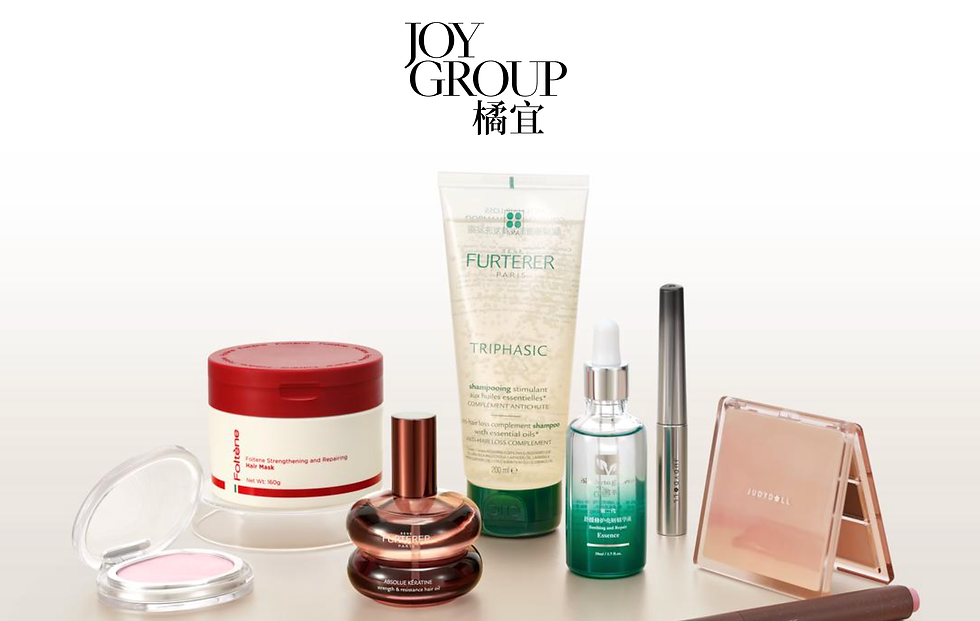
Company Overview: Who Is Joy Group?
Founded amid China’s booming new consumer wave in 2016, Joy Group initially rose through its sharp focus on color cosmetics — one of the most competitive and fast-evolving segments in China’s beauty market.
Over the past few years, the group has grown into a leading player in domestic color cosmetics, supported by:
● Strong product development capabilities
● Deep integration with China’s digital content and e-commerce ecosystem
● An increasingly sophisticated multi-brand strategy
Rather than functioning as a single-brand success story, Joy Group operates more like a brand-building platform, capable of nurturing, scaling, and managing brands with different positioning and consumer appeal.
This evolution mirrors a broader trend within China’s consumer sector: the emergence of companies moving beyond viral hits toward more sustainable, group-level growth.
Two Brands, Two Logics: Judydoll and Joocyee
Judydoll (橘朵): Efficiency-Driven Mass Beauty

Judydoll represents Joy Group’s efficiency engine.
Positioned at accessible price points, the brand focuses on high-frequency makeup categories such as lip products, eye makeup, and base essentials. Its success is built on:
● Fast product iteration
● Clear functional messaging
● Strong value-for-money perception
Judydoll thrives in China’s high-velocity retail environment, where rapid feedback loops between content platforms, e-commerce data, and supply chains allow brands to scale winning products quickly.
Joocyee (酵色): Aesthetics, Emotion, and Brand Building
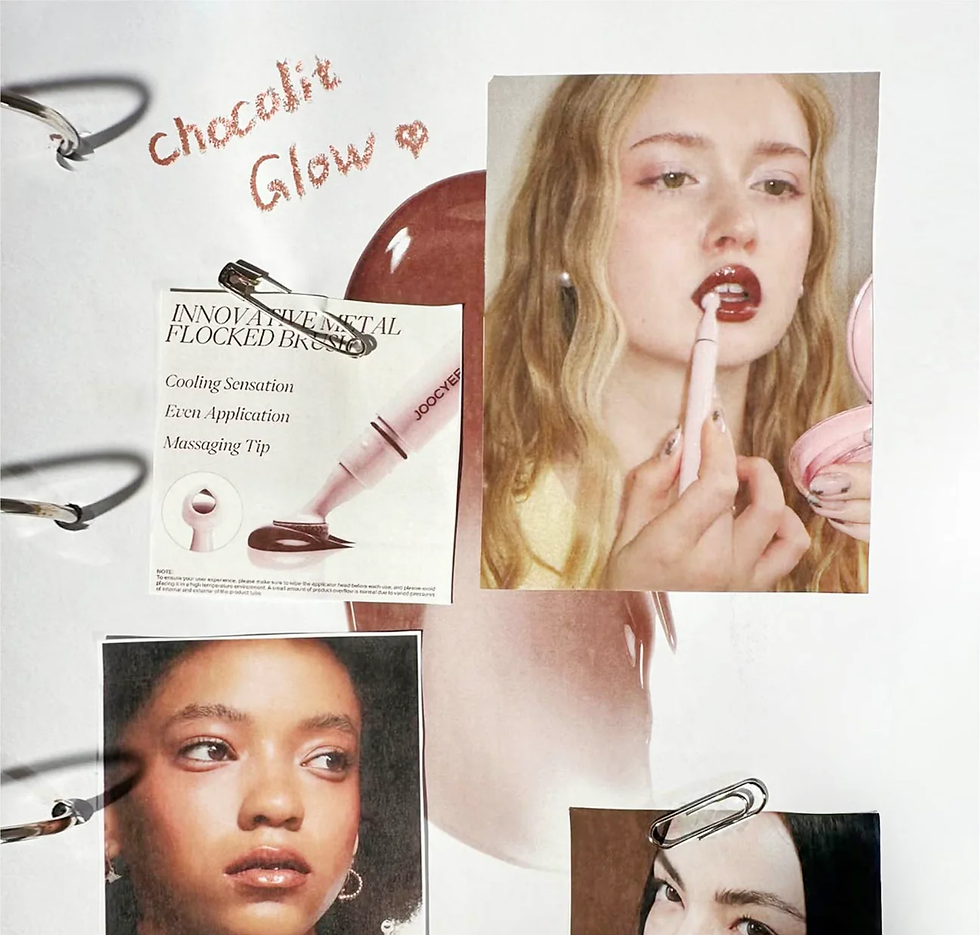
Joocyee follows a very different playbook.
With stronger emphasis on visual identity, packaging design, and emotional storytelling, Joocyee targets consumers who view makeup not just as a utility, but as an extension of personal aesthetics and self-expression.
This positioning allows Joocyee to build deeper brand affinity and longer-term brand equity. These attributes often translate more effectively in cross-border and global markets.
A Portfolio, Not an Internal Competition
Rather than competing internally, the two brands allow Joy Group to:
● Address distinct consumer mindsets
● Balance short-term efficiency with long-term brand value
● Reduce reliance on any single growth engine
This portfolio logic is a key reason Joy Group has maintained momentum even as China’s broader “new consumer” boom has cooled.
Why Joy Group Wins in China
1. Product Selection with Strategic Entry Points
Rather than chasing every trend, Joy Group’s brands chose product categories with natural consumer pull:
● Judydoll’s single-color eyeshadows enhanced DIY creativity and basket size
● Joocyee’s lip creams offered differentiated tactile and emotional appeal
These entry points helped both brands build category credibility organically, rather than relying solely on transient hype.
2. Mastery of China’s Content Ecosystem
Joy Group treats content platforms not just as marketing channels, but as real-time consumer research tools.
Platforms like Xiaohongshu help identify emerging trends and unmet needs, while short-video and livestream platforms accelerate scaling once a product resonates. Content, commerce, and product development operate as a closed loop.
3. Supply Chain and Organizational Discipline
Behind the scenes, Joy Group benefits from strong internal coordination between product teams, sourcing, and operations. This enables cost control, stable quality, and resilience, which are particularly important in a post-hype era for China’s consumer brands.
Going Global: How Judydoll and Joocyee Are Expanding Overseas

Starting with Culturally Adjacent Markets
Joy Group’s international expansion has so far prioritized markets with closer cultural and beauty consumption similarities to China, including:
● Japan
● Singapore
● Southeast Asia
These regions already possess mature beauty consumers familiar with Asian beauty trends, thanks to the long-standing influence of Japanese and Korean beauty brands.
By the end of 2024, Joy Group’s international business had grown over 400 % year-on-year, with products from Judydoll and Joocyee now sold in more than 30–50 markets. The group has also established local subsidiaries and teams in Singapore, Indonesia, Vietnam, and the Middle East, underscoring a strategic shift from purely cross-border ecommerce toward localized market operations.
Channels and Presence
Joy Group’s overseas footprint includes:
● Cross-border ecommerce distribution
● Partnerships with localized retail channels
● Early experiments with standalone retail formats in select cities (where relevant data is publicly available)
While awareness remains lower in Europe and North America compared to Japan and ASEAN markets, the rapid expansion suggests brand positioning is resonating beyond China’s borders.
Why Joy Group Could Be Competitive Overseas
When viewed through a global lens, Joy Group’s advantages extend beyond individual products.
Compared with Western indie beauty brands, it offers:
● Faster product development cycles
● More flexible cost structures
Compared with Japanese and Korean peers, it demonstrates:
● Stronger integration with content-driven trend discovery
● Greater agility in testing and scaling new ideas
More importantly, Joy Group’s real export may not be a single hero product, but its organizational system — a repeatable model for building, managing, and evolving beauty brands in fast-changing markets.
Conclusion: Different Paths, Same Destination
Joy Group’s trajectory differs from other Chinese beauty brands featured in the Chinese Brands Global Playbook series, such as Flower Knows(花知晓) with its fantasy-driven visual storytelling, or Florasis(花西子), which anchors its global expansion in Chinese cultural aesthetics.
Their growth paths are distinct. Their brand languages are different. Yet they converge on the same destination: moving beyond China’s domestic market to participate in global beauty competition on their own terms.
For overseas investors, brand owners, and distribution partners, Joy Group illustrates a new reality. China’s beauty exports are no longer limited to products, they are exporting systems, capabilities, and a new way of building brands at scale.
And this story is only beginning.


Comments