
The Norwegian Air Bet: How to Win the World Cup Without a Sponsorship Deal
Key Takeaways
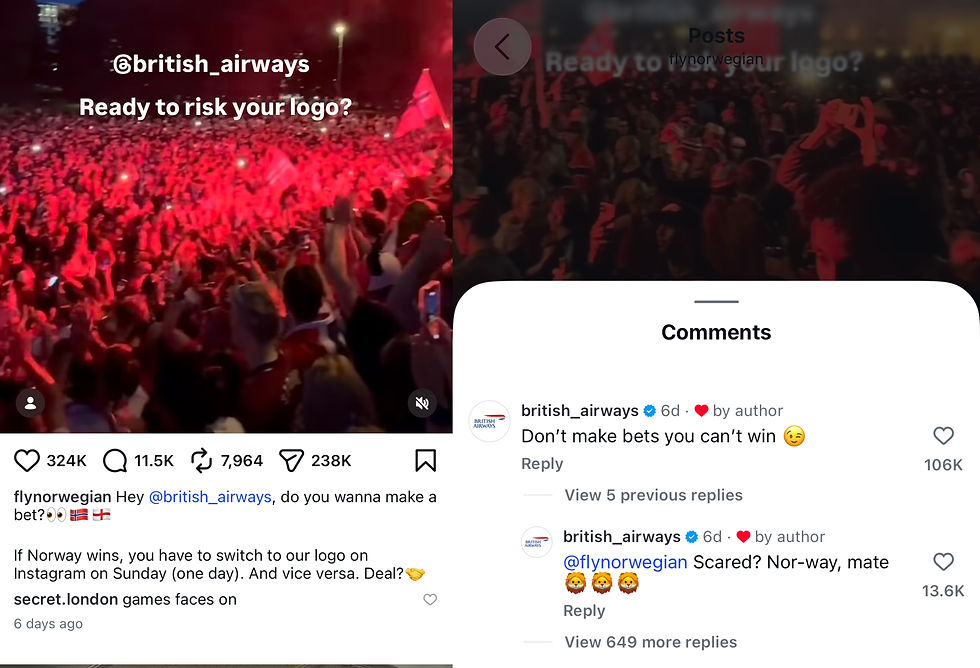
Days before the England vs Norway quarter-final, Norwegian publicly challenged British Airways on Instagram: the loser would wear the winner's logo as its profile picture for 24 hours.
The challenge post has drawn more than 324,000 likes as of July 14, hundreds of times Norwegian's typical engagement. Neither airline is an official FIFA sponsor.
Real-world execution, including a filmed handshake ceremony between staff of both airlines and a message delivered on a flight to Oslo, turned comment-section banter into a content series.
The bet was structured so that even losing produced the campaign's most shareable moment. Norwegian honoured the forfeit, then immediately converted the attention into a flash sale.
For emerging consumer brands, the playbook is replicable: borrow a big moment, pick a willing rival, stake something real, execute with humans, and capture the demand.

On the morning of July 12, anyone who opened Norwegian's Instagram profile found the airline wearing someone else's face. The logo of Scandinavia's best-known low-cost carrier had been replaced by the crest of British Airways, its rival across the North Sea. Nothing had been hacked and nobody had been acquired. Norwegian was simply paying up.
The forfeit settled the most-watched brand wager of the 2026 World Cup. Five days before England met Norway in the quarter-final, Norwegian posted a public challenge on Instagram: "Hey @british_airways, do you wanna make a bet?" The terms were simple. If Norway won, British Airways would change its profile picture to Norwegian's logo for a day, and vice versa. A Norwegian spokesperson explained the thinking with unusual candour: "What wager is fun without risk? And we thought, what's the most visible thing we can bet? Our logo."
England won 2-1 after extra time in Miami on July 11, ending the deepest World Cup run in Norway's history. The next morning, Norwegian's profile picture changed on schedule. By then, the two airlines had already run what may be the cheapest and most effective sports campaign of the year.
What Exactly Happened Between Norwegian and British Airways?
The exchange escalated in stages, and the staging is where the marketing lesson lives.
British Airways first let the challenge hang in the air, which only fed the story. Norwegian needled publicly: "Anyone heard from @british_airways while we slept??" When the reply came, it was pitch-perfect deadpan: "Scared? Nor-way, mate." From that moment the two comment sections effectively became one shared stadium.
Then the campaign left the screen. A member of Norwegian's social media team flew to London to exchange USB drives containing each airline's logo files, formalising the stakes in person, and British Airways sent back a note delivered on a flight to Oslo reading "IT'S COMING HOME!", the refrain of Three Lions, the 1996 anthem England fans have sung ever since about football returning to the country that codified it. The two airlines also filmed employees shaking hands to make the bet official, with Norwegian crew presenting a tiny cup of English tea for the occasion. British Airways added a zoom-in picture quiz for its followers, the blurred image resolving into an aircraft tail that read "It's coming home".

After the final whistle, Norwegian honoured the bet in full. The profile picture switched to the British Airways roundel, accompanied by "It's coming home" and "Well played England", and a caption noting that "while the tournament is over for us, this friendly bet will forever live in all our hearts". British Airways replied "We love this new look on you" and posted a farewell carousel captioned "Rivals for 90 minutes, friends forever." Norwegian then rolled out a flash sale on UK-Norway routes with the discount code FBALLCOMINGHOME, converting borrowed attention into bookings while the story was still warm.


The numbers, for two brands holding no tournament rights, were exceptional. Norwegian's challenge post drew nearly 75,000 likes within its first days, against the 400 to 1,500 its posts usually manage, and British Airways' reply passed 21,000. By July 14 the challenge post had climbed past 324,000 likes, still rising days after the final whistle. Neither airline is a FIFA sponsor, yet for a week they were arguably the most visible brands of the quarter-finals. KLM, Finnair, Riyadh Air, Wizz Air and a crowd of other carriers piled into the comments, extending the reach further at no cost to anyone.
Why Did the Norwegian Air Bet Outperform Official Sponsors?
Plenty of brands newsjack big events. Most of it evaporates within an hour. Four design choices made the Norwegian Air bet different.
The stake was real. Most brand banter risks nothing, which is precisely why audiences ignore it. Norwegian wagered the one asset a brand is never supposed to surrender: its own identity. A profile picture is technically trivial and symbolically enormous, and everyone watching understood instantly that something could actually be lost. It is the same insight that has turned brand merch from a freebie into a main course: identity assets carry emotional weight that media spend cannot buy.
The challenger moved first, and the incumbent chose to play. Norwegian is a fraction of British Airways' size, and the upside was correspondingly asymmetric: the smaller brand borrowed the bigger brand's audience simply by tagging it. For British Airways, accepting cost little and bought warmth that flag carriers rarely get on social media. There is a lesson on both sides. Challengers should pick fights that incumbents can safely join. Incumbents should recognise that being a good sport is sometimes the win itself.
Humans carried the story. Flying a staffer to London, exchanging USB drives, presenting a miniature cup of tea, filming a handshake: none of this was necessary to run the bet, and all of it was necessary to make people care. Visible effort is proof of commitment, and in feeds increasingly filled with templated brand content, it reads as sincerity. Fans repaid it by treating the airlines as characters in the tournament rather than advertisers around it. One widely shared comment put it best: "I wasn't watching England vs Norway. I was watching British Airways vs Norwegian."
Losing was designed to be the best content. The forfeit was not damage control. It was the payoff the entire audience had been waiting for, and it handed the loser its biggest post of the campaign. A structure in which every outcome produces shareable content is rare in marketing, and it was engineered here from the first post.
What Can Emerging Consumer Brands Copy From This Playbook?
None of the mechanics above require an airline's budget. For emerging brands, the campaign decomposes into five transferable moves.
Borrow a moment bigger than you. Cultural events arrive with built-in audiences, built-in emotions and built-in deadlines. The World Cup did the heavy lifting of attention; the airlines only had to attach themselves to it credibly. Norway's unexpected run, its first quarter-final ever, gave the bet genuine sporting tension that no brand could have scripted.
Pick a counterpart, not a victim. The banter worked because both sides consented to the game and neither punched down. The target of your challenge must have a reason to play along, and the tone must stay warm enough that fans of both brands enjoy the exchange. The moment rivalry reads as hostility, the asset becomes a liability.
Stake something that hurts to lose. A discount is not drama. An identity is. A coupon code wagered on the same match would have earned a fraction of the attention. The stake should be something your audience knows you care about: your logo, your name, your signature product, even your tagline. The visible possibility of loss is what turns spectators into stakeholders.
Execute in the physical world. One filmed gesture beats ten witty replies. The London visit and the tea cup gave editors and fans images to share, not just text to quote. For a small brand this can be as simple as hand-delivering a challenge to a rival's office and filming thirty seconds of it.
Capture the demand before it cools. Norwegian's flash sale went live while its own forfeit was still trending. Attention has a short half-life, and the bridge from joke to checkout was ready in advance. Any brand copying the banter without preparing the conversion step is doing charity for the algorithm.
Would this work in China? Our view is yes, very likely. Brand-to-brand banter is not unique to Instagram: on Weibo and Xiaohongshu, official brand accounts tease each other, ride memes and talk back to fans every day, and the mechanics of this campaign (a real stake, human execution, a structure where even losing produces great content) translate directly. What needs translating is the idiom, not the mechanism. The dry British register, the tea, the "It's coming home" in-jokes would all be rewritten in local internet language. For Chinese brands going global and international brands heading the other way, the discipline is the same: keep the mechanics, rewrite the voice for the platform culture it lives in.

Will This Still Work When Every Brand Copies It?
England now face Argentina in the semi-final, and it is safe to assume marketing teams across Europe and South America spent this week drafting wagers of their own. Expect a wave of copycat bets by the final, and diminishing returns with them. The first mover earned hundreds of times its normal engagement. The tenth will be lucky to earn a shrug.
What will not fatigue are the underlying principles: a real stake, a willing counterpart, human execution, and the operational agility to clear legal and brand approvals at the speed of sport. That last point is the quiet differentiator. A wager like this dies in most organisations because nobody can sign it off within a news cycle. The brands that pre-agree guardrails for real-time play will keep finding moments like this one. The brands that convene a committee will keep watching from the stands.
Double V is a cross-border operating partner and intelligence house for emerging consumer brands, based in Hong Kong and Shenzhen. We help brands connect China and the world through three businesses: Brand Operation (marketing and distribution for brands on retainer), Brand Incubation (sister company Glam Infinite and our own-built brands), and Industry Intelligence (cross-border research and reports). Talk to our team.


Comments