
The Vacation Sunscreen Bet: Selling Leisure, Not Fear, All the Way to US$80 Million
For four decades, sunscreen marketing has run on one emotion: guilt. Wear it or age. Wear it or burn. Wear it or worse. The category professionalised itself into a daily obligation, and somewhere along the way it stopped being any fun. Vacation was built on the opposite premise. Its founders looked at a product people apply on the best days of their lives, at the beach, by the pool, on holiday, and asked why it was being sold like medicine.
The answer they shipped in 2021 was not really a sunscreen at all. It was a fictional 1980s resort world, complete with fake employee badges, a banana-and-coconut signature scent composed by fine-fragrance perfumers, and an SPF mousse that comes out of a whipped-cream can. Behind the joke sits a very serious business. The brand is profitable and projected to double sales to roughly US$80 million, all on total funding of about US$11.2 million. This DTC brand breakdown looks at how far a world-view can carry commodity chemistry, and where the limits are starting to show.
Who Buys Vacation Sunscreen? The Shopper Who Hates Sunscreen
The Vacation sunscreen customer is not the SPF obsessive. Dermatology-first buyers already have La Roche-Posay and Supergoop, and K-beauty importers serve the texture connoisseurs. Vacation aimed at the much larger group in the middle: people who know they should wear sunscreen, resent being lectured about it, and only think about the category a few times a year, usually in a good mood.
That reframing matters commercially. If sunscreen is medicine, it is bought on efficacy claims and dermatologist endorsements, a game where scale and clinical budgets win. If sunscreen is part of the holiday itself, like a swimsuit or a cocktail, it is bought on scent, packaging and mood, a game a small brand can win on taste. Vacation deliberately sells the second product. Its tagline is not about protection at all. It is "The World's Best-Smelling Sunscreen".
The buyer skews female and social. Suncare sits inside the beauty aisle, and the formats are engineered to be photographed, handed around and talked about. A can of SPF that looks like whipped cream does half its own marketing every time it appears beside a pool. The purchase is closer to buying a souvenir than buying a drug, and souvenirs carry far better margins and far more forgiveness on price.
What You Are Really Buying: Commodity SPF in a Costume
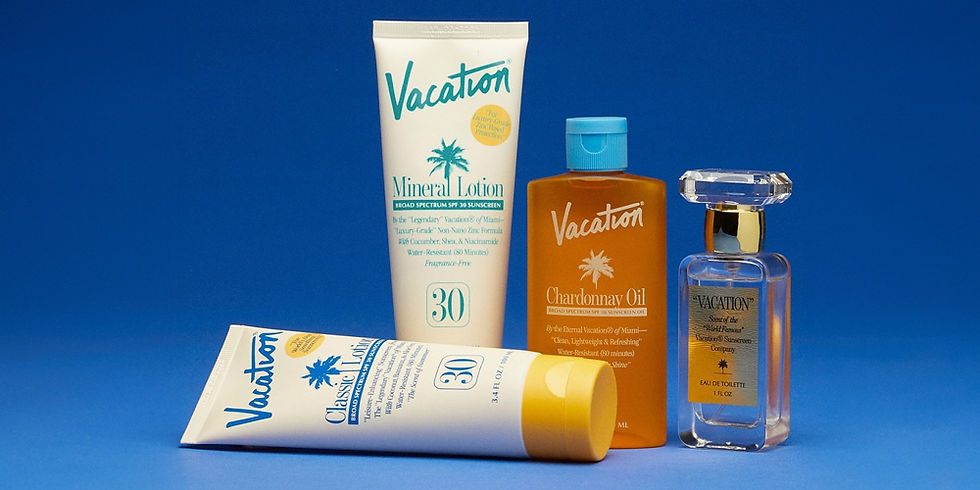
Strip the branding and the chemistry is deliberately conventional. What Vacation engineered instead is format and scent. Classic Whip, a sunscreen mousse dispensed from a whipped-cream canister. Chardonnay Oil, an SPF body oil themed like a poolside pour. Shimmer Oil, Baby Oil with modern filters, and eau de toilettes that bottle the smell of the sunscreen itself. Every product is a small piece of theatre, and the theatre is the differentiation.
The scent is the moat most analysts miss. The signature banana-coconut accord was developed with perfumers from Arquiste and Givaudan, fine-fragrance talent applied to a mass suncare product. Scent is the strongest memory trigger in consumer goods, and Vacation effectively owns "smells like holiday" the way Sol de Janeiro owns its gourmand beach scent. It is no coincidence that a Sol de Janeiro co-founder invested in the brand.
The costume has a cost, though. In August 2025, the US FDA sent warning letters to five suncare players, including Vacation, over whipped and mousse sunscreen formats that fall outside permitted OTC forms, and flagged that Classic Whip's whipped-cream canister could invite accidental ingestion. When your differentiation is the format, format regulation is a direct hit on the moat. How Vacation re-engineers its hero product without killing the joke is now one of the brand's defining product questions.

Why It Worked: Small Money, Loud World-Building
Vacation's capital story is the part emerging brands should study hardest. The company closed an oversubscribed US$6 million Series A led by Silas Capital in May 2023, with True Beauty Ventures, BFG Partners, Sonoma Brands and angels including Bluemercury co-founder Marla Beck. That is seed-stage money by beauty standards. Supergoop needed years of education spending and ultimately Blackstone's backing to make SPF a prestige category, a story we broke down in our Supergoop analysis. Vacation spent a fraction of that by letting the brand world do the advertising. The capital markets noticed: in March 2026 the brand landed a minority investment from VMG Partners, the consumer fund that backed Drunk Elephant before its sale to Shiseido.
The mechanics are visible in every channel. The fake corporate identity gives customers a role to play: fans sign up as "employees" of a resort that does not exist, and user-generated content follows for free. The products are engineered to be conversation pieces on the shelf, which is why retail followed so quickly. After entering Ulta Beauty, the brand reached mass doors, and by 2026 Target was expanding its Vacation Brand SPF collections as part of its largest-ever spring beauty assortment. A brand built as an internet in-joke now sits in the most mainstream aisle in America, priced masstige at roughly US$15 to US$25.
Compare the same trick in a different category: Starface turned an acne patch, another commodity people were embarrassed by, into a visible badge. In both cases the pattern is identical. Take a functional product sold on anxiety, invert the emotion, and let a strong aesthetic point of view replace paid acquisition. The moat is not the formula. It is the permission the brand gives its customer to enjoy something.
The Origin Story: A Radio Station That Only Played Summer
Vacation did not start as a beauty company. Co-founder Marty Bell ran Poolsuite, a retro internet radio platform styled like a 1980s Miami pool party, and its cult following was the brand's first audience. Lach Hall and Dakota Green came from advertising and brand building, and Hall has described the idea surfacing while the founders worked remotely from a beach in Mexico, wondering why a product used on the best days of the year was so joyless. The company was, in effect, a media property before it was a product company, which is the reverse of how most beauty brands are built.
The audience-first sequence shows up in the numbers. When the brand tested its first sunscreen-scented fragrance, it cut the production run to 500 units out of caution, and the entire run sold out within hours of launch. Demand kept outrunning a supply chain built for a limited edition. That is what happens when distribution is a community rather than a media budget.
The clearest expression of the playbook is Orange Gelée. The cult sunscreen originally created in 1926 was discontinued in 2019, and Vacation revived it, drawing a 16,000-person waitlist and selling out within three days. In 2026 the brand threw the product a 100th birthday campaign, complete with a fragrance collection and a US$9.99 throwback promotion at Target. Vacation does not just use nostalgia as a visual style. It acquires and operates other people's nostalgia as an asset, which is a genuinely unusual capability for a company this size.

What Emerging Brands Should Take From This
The tempting read is that world-building is free growth. It is not free. It is a different cost structure. Vacation substituted creative discipline for media spend, and that discipline is rare: the tone never breaks character, the collaborations stay on-theme, and the product pipeline keeps feeding the fiction. Most brands that copy the surface, retro fonts and jokey copy, discover that an aesthetic without an operating system behind it is just packaging.
For Chinese brands eyeing this model, the supply-chain reflex is the trap. The instinct is to note that the formula is commodity chemistry and conclude the category is easy to enter. The formula was never the product. The product is a coherent fictional world maintained over five years, and the willingness to buy cultural assets, like a discontinued 1926 sunscreen, that no spreadsheet would justify. That is brand equity built the slow way, then monetised fast through mass retail.
The open questions are real: the FDA action strikes at the hero format, and nostalgia cycles eventually age. But the VMG deal has already answered the pricing question: sophisticated consumer investors will pay for a coherent world, not just a P&L. And the core proof stands. On about US$11 million of capital, Vacation sunscreen turned the least loved product in the beach bag into the thing people post first. In a category the giants own on trust, the brand found the one shelf they could not defend: joy.
Double V is a cross-border operating partner and intelligence house for emerging consumer brands, based in Hong Kong and Shenzhen. We help brands connect China and the world through three businesses: Brand Operation (marketing and distribution for brands on retainer), Brand Incubation (sister company Glam Infinite and our own-built brands), and Industry Intelligence (cross-border research and reports). Talk to our team.


Comments