
Pop Mart’s Overseas Sales Just Fell for the First Time. Was Labubu a Brand or a Moment?
A company that grows 23.8 percent in half a year does not usually spend the following week reassuring investors. That is where Pop Mart found itself in late August. The Beijing collectible toy group reported revenue of RMB 17.17 billion for the first half of 2026, up 23.8 percent year on year, and still watched its shares fall as much as 8.9 percent in Hong Kong, with founder Wang Ning conceding that the 20 percent growth target for the year would be difficult to achieve. The line investors were actually reading sits in the regional table: overseas sales fell for the first time since Pop Mart went global.
The overseas line matters because, for the past two years, it was the story. Labubu, the snaggle-toothed elf from the THE MONSTERS family, turned a Chinese blind-box retailer into the most closely watched IP exporter in consumer goods. The character showed up on celebrity handbags, in resale bubbles, and, as we wrote earlier this year, on a co-branded refrigerator. Wherever Chinese founders gathered to talk about going global, Labubu was the proof that it could be done.
The first half of 2026 is the first hard look at what comes after that kind of moment. It is not a collapse. It is something more instructive: a company discovering, in public, the difference between exporting a product and exporting a brand.

How Pop Mart’s Overseas Engine Went Into Reverse
The regional split is stark. Overseas revenue fell 11 percent year on year to about RMB 4.97 billion, with Asia-Pacific down 9.7 percent, the Americas down 16.5 percent, and Europe the only overseas region still growing, up 5.9 percent. Greater China moved in the opposite direction, and sharply. The company that spent 2025 being described as a global phenomenon is, for now, growing almost entirely at home again.
Some of this is arithmetic. The comparison base is brutal: in the first half of 2025, overseas revenue grew 440 percent to RMB 5.6 billion, the steepest stretch of the Labubu wave. Lapping that period was always going to look ugly, and a decline against that base is not the same thing as a business in freefall. But a base effect explains deceleration, not contraction. A brand with durable overseas demand slows from 440 percent growth to 40 percent, or to 15. It does not usually go negative while still opening stores. The mood swing is best measured against July 2025, when Wang Ning told People’s Daily that Labubu could sell close to 10 million units a month from that September.
The IP mix tells the sharper story. THE MONSTERS family, home to LABUBU, posted revenue of RMB 4.45 billion, down 7.5 percent year on year, its first-ever decline, with its share of total revenue falling from 34.7 percent to 26 percent. And it happened in the same half in which the China operation posted its best growth in years.
More Stores, Less Money: The Expansion Paradox
Pop Mart kept building through the slowdown, and nowhere more than in the region where revenue fell hardest. In the Americas, the company added a net 22 stores over the six months, bringing the count to 86, while regional revenue came in at RMB 1.89 billion.
That combination, more doors and less revenue, is the most uncomfortable data point in the report. It means per-store sales fell considerably faster than the headline numbers. The queues outside American mall stores in 2025 were real, but a queue measures a moment, and a lease runs for years. Pop Mart signed retail commitments against demand that was partly a social phenomenon, the kind that fills a store for one season and moves on.
Physical retail also cuts both ways on the way down. A store network built for peak traffic carries rent, staff and inventory that do not shrink with demand. Roboshops soften this, which is partly why Pop Mart leans on them, but flagship-heavy expansion in high-rent Western retail corridors is a bet on demand staying near its peak. When it does not, the operating leverage that flattered the numbers in 2025 starts working in reverse.
None of this is new to hype-driven categories. Sneakers, energy drinks and collectible cards have all lived through the same cycle, and we watched a Chinese version of it when trading cards swept China’s Gen Alpha. What is unusual here is the speed at which overseas exposure grew before the test arrived. In under two years, international sales went from a side bet to the core of the bull case. The first half of 2026 repriced that case in a single morning.

One Viral IP Is Not a Brand
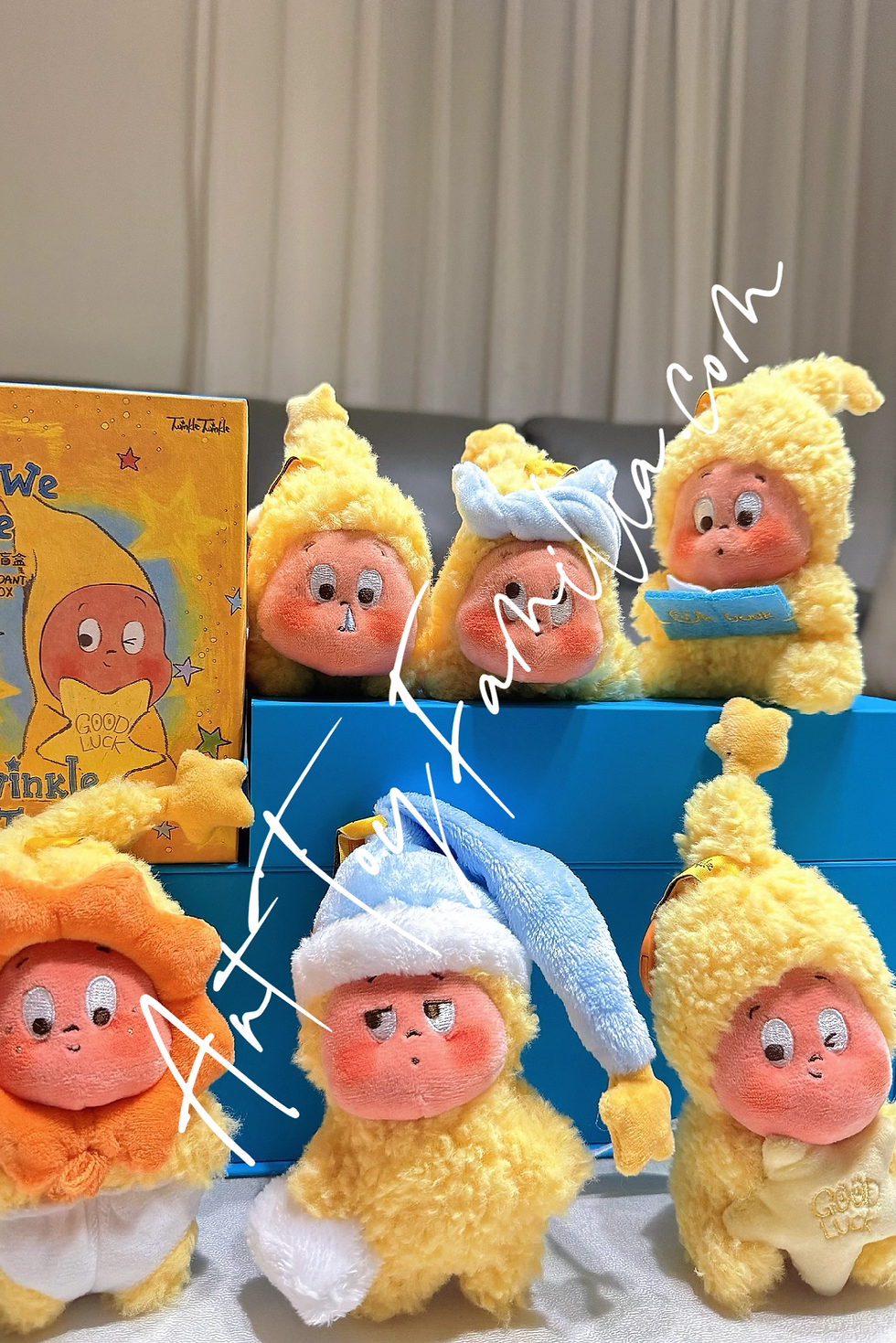
The domestic contrast is what makes the overseas number legible. Greater China revenue rose 47.3 percent, and the company’s new star IP, Twinkle Twinkle, surged more than 580 percent to become its fastest-growing IP family. At home, Pop Mart is demonstrably not a one-IP company. When Labubu cooled, another family absorbed the demand.
There is a context behind that 47.3 percent that is easy to miss: it was delivered in a year when China's offline toy retail cooled visibly. In the first half of 2025, at least 155 guzi stores, shops selling anime and character merchandise, closed or announced closure nationwide, and into 2026 some cities saw closures running at twice the pace of a year earlier; Pop Mart itself abruptly called off PTS Shanghai, the toy carnival it had scheduled for July. The market did not crash, the guzi economy still grew nearly 20 percent in 2025, but the action concentrated at the top: small shops with no IP of their own, stocked on whatever was trending, exited in batches, and growth flowed to companies that both create IP and control channels. By our math from the interim report, the revenue added by Twinkle Twinkle alone accounted for nearly six-tenths of the increase in Greater China revenue. In other words, the domestic surge is less a rising tide than consolidation in a shakeout, and what props up that concentration is new IP like Twinkle Twinkle.
The difference between the two markets is infrastructure. In China, Pop Mart operates a conversion machine built over more than a decade: hundreds of stores, thousands of roboshops, a drop calendar, and a membership system designed to move a customer from her first blind box to her fifth IP family. Fans age into new IP as old ones cool. The portfolio, not any single IP, is the product.
Overseas, most customers arrived through a single door marked Labubu. They came from TikTok clips and celebrity sightings, bought the IP, and left. The machinery that converts a one-time buyer into a collector exists in a handful of flagship cities at best. When the IP cooled, there was nothing behind the door for those customers to find.
The distinction shows up in how a purchase happens. A collector in Shanghai checks the release calendar, queues for a specific drop, trades doubles with other members, and has opinions about which artist’s next series is underrated. A shopper in an American mall in 2025 bought a Labubu because it was everywhere that month. The first behavior compounds; the second one ends. Both look identical in a quarterly revenue line, right up until they do not.
What Sanrio Knows About Outliving Its Own Star IP
There is a playbook for this, and it is Japanese. Sanrio built Hello Kitty into one of the highest-grossing IPs in history, then spent years shrinking on her back as the icon aged. Under CEO Tomokuni Tsuji, grandson of founder Shintaro Tsuji, the company deliberately rebuilt itself around a broader IP portfolio, so that when one declines, another fills the gap. Operating profit reached a record high in the fiscal year ended 31 March 2025; Hello Kitty now accounts for around 30 percent of Sanrio’s gross profit in product sales and licensing, down from 76 percent a decade ago.
Pop Mart is attempting the same rotation at far higher speed, in the middle of the drawdown rather than after it, and with direct retail exposure that Sanrio’s licensing-heavy model never carried. Twinkle Twinkle’s surge proves the IP pipeline works in China. The unanswered question is whether a second family can travel abroad on its own, without a viral accident to carry it. Nothing in the first-half numbers yet shows that it can.
There is also a structural difference between Pop Mart and Sanrio worth naming. Sanrio earns much of its money through licensing, which means partners carry the retail risk when an IP cools. Pop Mart owns its stores, its inventory and its supply chain, so a cooling IP lands directly on its own results. That makes the portfolio rotation more urgent for Pop Mart than it ever was for Sanrio, not less.
The Real Lesson for Chinese Brands Going Global
Labubu should still be remembered as a breakthrough: proof that an original Chinese IP could reach the global mainstream without a film studio or a streaming platform behind it. That does not disappear because one half-year went negative. But the sequel matters more than the debut. When Chagee listed on Nasdaq, we argued that capital markets were buying a global story. Pop Mart’s results show the other side of that trade: the story gets repriced the moment repeat behavior fails to show up.
For founders building toward international markets, the working distinctions are worth writing down. A queue measures attention; a repeat purchase rate measures a brand. Store expansion should follow retention data, not headlines. And the second product has to be in the pipeline before the first one peaks, because by the time a peak is visible in the numbers, it has already passed.
The measurement discipline matters most. In our own work with brands entering new markets, the numbers that predict year three are rarely the ones celebrated in year one. Repeat rate, cohort retention and full-price sell-through tell you whether a market wants the brand or merely met the product. Pop Mart has those numbers for China, which is why the home business keeps compounding. Whether it has them for Ohio or Manchester is, on the evidence of this report, still an open question.
Pop Mart is not a company in trouble. Its China engine just accelerated, its margins remain the envy of the toy industry, and it has minted more than one hit IP. What the first half of 2026 ended is a specific illusion: that virality abroad and brand equity abroad are the same thing. Over the next year, three numbers will show which one Pop Mart actually owns outside China: per-store revenue in the Americas, Twinkle Twinkle’s sales overseas, and how much of international revenue comes from customers buying for the second time.
Double V is a cross-border operating partner and intelligence house for emerging consumer brands, based in Hong Kong and Shenzhen. We help brands connect China and the world through three businesses: Brand Operation (marketing and distribution for brands on retainer), Brand Incubation (sister company Glam Infinite and our own-built brands), and Industry Intelligence (cross-border research and reports). Talk to our team.


Comments