
The Huel business model, decoded: how a £214m subscription engine was built, and why Danone wants it
Key Takeaways
Customer (WHO): time-poor, health-conscious early adopters who skewed roughly 70/30 male in the early years, reached first through Huel's own site and held by recurring subscriptions and a self-styled "Hueligan" community, with newer formats steadily widening the base toward women.
Product (WHAT): a deliberately narrow promise, a meal that is nutritionally complete for around US$2.65, extended across powders, ready-to-drink, bars and hot meals so members buy more without costing more to acquire.
Marketing (WHY): the Huel business model runs on subscription, owned data and a vertically integrated supply chain, with paid media and celebrity backers layered on top rather than leading.
Brand story (HERSTORY): a marketer and a nutritionist launched a single "nutritionally complete" powder from Buckinghamshire in 2015, stayed profitable from day one, built it into a £214m brand, and saw a "tech-bro" product quietly adopted by women as a way to reclaim time.
For consumer founders: Huel shows that profitability and customer ownership, not headline growth alone, are what turn a DTC brand into a strategic acquisition target.
Most direct-to-consumer success stories follow the same arc: raise aggressively, spend on paid social from day one, chase growth ahead of margin, and hope an exit arrives before the cash runs out. Huel did almost none of that. It sold directly online, ran at a profit from its first full year, took outside money only when it wanted to, and a decade later became the kind of asset a multinational is willing to pay close to a billion euros to own.
That makes the Huel business model a useful case to study from the outside in. We will break it down with our WWW.HER framework, four dimensions of any consumer brand: the customer (WHO), the product (WHAT), the marketing engine (WHY) and the brand story (HERSTORY). Each one explains a different reason the company stayed profitable while scaling, and why Danone now wants it.
WHO: Who buys in, and why they stay
Huel's core customer is time-poor and health-conscious, the kind of person who wants a balanced meal without cooking or queueing. The base skews male and young: in its early scaling years the buyers were mostly early adopters aged 25 to 45 with a roughly 70/30 male-female split, over-indexing on tech and fitness. Originally that customer was reached almost entirely through Huel's own website and app, a textbook direct-to-consumer approach that handed the brand first-party data and a direct relationship with every buyer.
Retention is built into the model. A large share of Huel's buyers sit on recurring, subscription-style orders, the kind of habitual repurchase that turns a consumable into predictable revenue. The brand reinforces that habit with identity: customers call themselves "Hueligans," a self-named community that shares routines, recipes and results, so staying subscribed feels like belonging rather than just reordering.
Retail came later, and fast. In the year to July 2024 Huel reported revenue of £214m, tripled pre-tax profit to £13.8m, and expanded its retail footprint 128% to more than 25,000 stores, while keeping DTC at the centre of the model. The United Kingdom remains its largest market, followed by the United States. Like other digitally native brands that scaled across borders, Huel used the website to prove demand first, then let retail extend reach.
The move into supermarkets did not dilute the direct model so much as feed it. Retail introduces the brand to shoppers who would never have found it online, and a share of those buyers convert into higher-value subscribers on Huel's own platform, where both the margin and the data are better. In effect, shelves became a paid acquisition channel that also generates revenue, an inversion of the usual fear that retail cannibalises DTC.
WHAT: What you are actually paying for
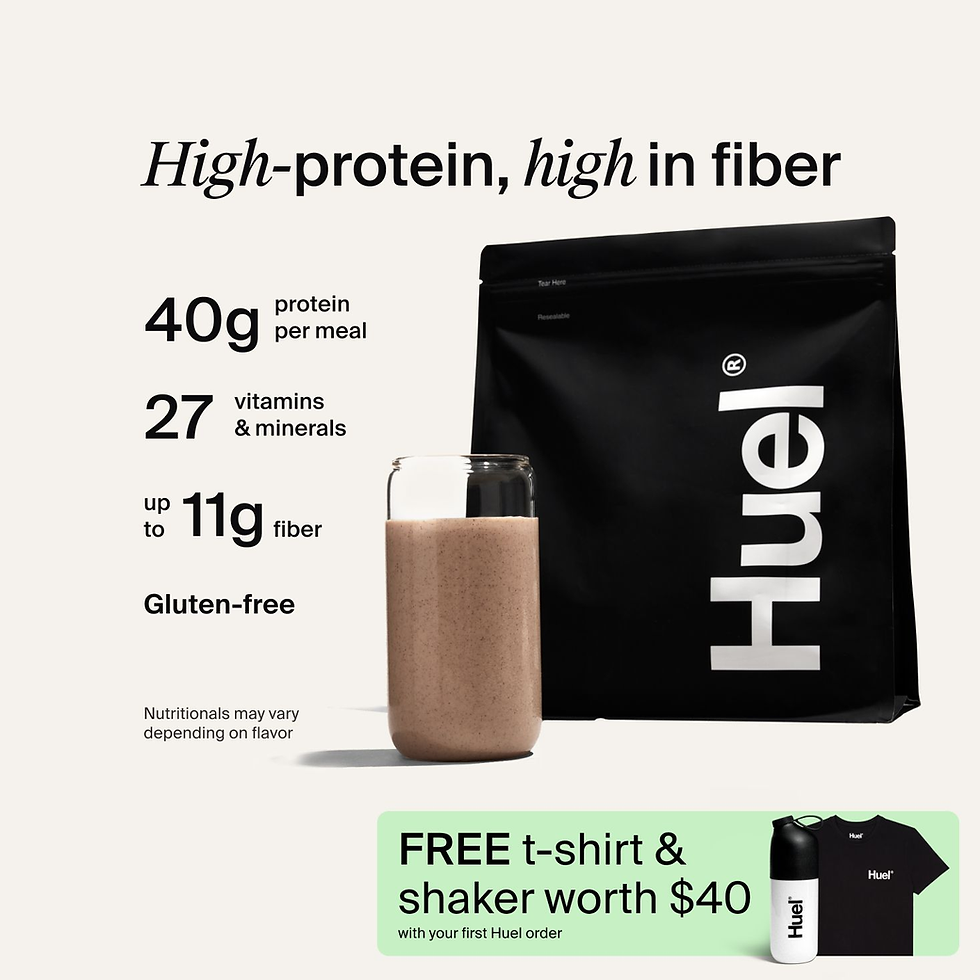
The product promise is deliberately narrow: a meal that is "nutritionally complete," with protein, carbohydrates, fats, fibre and the full set of essential vitamins and minerals in every serving. The flagship Black Edition powder sells for about US$2.65 per meal, undercutting most prepared food on a cost-per-meal basis. That clarity makes the value proposition easy to grasp and easy to repeat-buy.
Breadth then reinforces the engine. Huel has extended from a single powder into ready-to-drink bottles, bars, hot meals and greens, giving members more reasons to stay subscribed and lifting average order value without lifting acquisition cost. As the WHO section showed, each new format is sold into the same community and runs through the same logistics, so the incremental cost of launching one is low. A narrow promise executed across many formats is what lets a commodity input compound into a brand.
Vertical integration is the part most copycats miss. Huel brought meal production in-house at a Milton Keynes factory in 2024, giving it more control over cost, quality and supply as volumes grow. Owning the factory protects the per-meal economics that make the price promise credible, and it is far harder to replicate than a label or a flavour. Together, a sharp product, a recurring revenue model and growing control of the supply chain explain why the Huel business model has stayed profitable while scaling.

WHY: Why the Huel business model defends its margin
The commercial engine is subscription. Huel's Subscribe and Save gives a standing discount in exchange for recurring orders, turning a consumable into predictable, compounding revenue and lowering the need to keep re-acquiring customers. Subscription has been central to the Huel business model, even though, as we have written, the Western subscription model never really took hold in China. The lesson is that the format works best where convenience and routine, not novelty, drive the purchase.
Owned demand is the second layer. Because Huel reached buyers through its own site first, it controls the data and the relationship, which keeps customer acquisition efficient and makes paid media a multiplier rather than a crutch. The brand did eventually advertise at scale, running broad campaigns like "Every Fire Needs its Fuel" once demand already existed. Celebrity backers reinforced rather than created that demand: Idris Elba came on as a long-time user and investor before the brand spent heavily on media, lending credibility without a traditional endorsement deal.
Put together, the three layers, recurring revenue, owned data and an in-house supply chain, are what let Huel grow without surrendering margin. Most DTC brands can do one of these. Doing all three at once is why the company kept its profit growing even as it pushed into 25,000 retail doors and multiple markets. The marketing engine is not a single clever channel. It is a system designed so that each part lowers the cost or raises the value of the others.
HERSTORY: A profitable powder, and the women who turned a "tech-bro" brand into a daily ritual
In 2015, former marketer Julian Hearn and nutritionist James Collier launched Huel from a small operation in Buckinghamshire. The name is a contraction of "Human" and "Fuel," and the first product was a single powdered meal engineered to be nutritionally complete. From day one the company sold directly to consumers online and ran at a profit, an unusually disciplined posture for a venture-era consumer brand.
That discipline shaped everything that followed. Hearn had built and sold a previous business before Huel, and he kept the new company lean, reinvesting cash flow rather than chasing growth at any cost. Huel took its first outside capital only in 2018, when it raised £20m at a valuation near £220m. A second round in late 2022 valued the company at US$560m and added actor Idris Elba to the cap table, by which point the brand had sold more than 270 million meals worldwide.
The clearest evidence the model works is the income statement. A year after breaking the £200m mark, Huel lifted pre-tax profit around 40% to £19.4m, with UK sales up 26.5% to £139.3m. Profitable scale, not just a fast top line, is what eventually made the company a target for a multinational buyer.
The more interesting part of the story is who the brand grew into. Huel launched with a "tech-bro" reputation, the meal of choice for Silicon Valley men chasing "optimisation," and the male-skewed base reflected it. But by 2019 the New Statesman was documenting a quieter shift: "Huelling" had become popular among women, who described it as a feminist way to take back time lost to the unpaid household labour that still falls disproportionately on them. Where older female meal replacements like Slim Fast had sold weight loss, Huel sold a like-for-like meal, fuel rather than a project to change your body, and that framing landed.
Huel leaned into the shift rather than leaving it to chance. Supermarket distribution and new ready-to-drink formats helped the brand reach more women, and its own content now speaks directly to them, with a published guide to weight training for women that cites research on strength training, body image and bone health after menopause. The female story here is not a marketing campaign so much as a customer base the founders did not fully design for, then learned to serve.
What ties it together is how little outside money Huel needed to reach this scale. Where many direct-to-consumer brands raised aggressively and chased growth ahead of margin, Huel funded most of its expansion from its own cash flow and kept ownership concentrated. That choice handed the founder leverage at the negotiating table years later, and it is the single most underappreciated part of the story for anyone building a consumer brand today.

What consumer founders going global can take from Huel
In March 2026, Danone agreed to acquire Huel in a deal reported at close to €1bn, a windfall of around £400m for the founder. The transaction is now under regulatory review and has not yet completed, and the brand is expected to keep operating as an autonomous unit. For a strategic buyer, the appeal is a profitable, fast-growing brand in functional nutrition, a category Danone had been trying to build organically.
That logic is familiar. Large groups increasingly prefer to buy proven, profitable brands rather than build from scratch, a pattern we have traced in beauty as well. Huel offered Danone an established community, a working DTC engine and double-digit growth, the kind of asset that is far cheaper to acquire than to recreate.
The risks are real, though. Huel has had advertising claims challenged by the UK regulator, and a late-2025 Consumer Reports investigation flagged elevated levels of lead and cadmium in a Black Edition serving, drawing class-action lawsuits in 2026. It competes with AG1, MyProtein and Soylent, and even with Danone's own meal-replacement line. The integration question is whether a brand built on agility and a distinct voice can keep both inside a multinational.
For Chinese consumer companies eyeing overseas assets, the takeaway is not the price tag but the sequence. Whether or not the Danone deal closes on the reported terms, the signal is already clear: functional nutrition has matured from a fringe category into one the largest food companies feel they must own, and the fastest way in is to buy a brand that already has the community and the cash flow. Huel became worth buying because it was profitable, owned its customers, and never confused growth with health. That is the template a Western strategic buyer pays a premium for.
Double V is a cross-border operating partner and intelligence house for emerging consumer brands, based in Hong Kong and Shenzhen. We help brands connect China and the world through three businesses: Brand Operation (marketing and distribution for brands on retainer), Brand Incubation (sister company Glam Infinite and our own-built brands), and Industry Intelligence (cross-border research and reports). Talk to our team.


Comments