
From Acquiring to Investing: What L’Oréal’s Bet on LAN Reveals About China’s Beauty Market
When L’Oréal announced its minority investment in LAN, a fast-growing Chinese skincare brand, the headline travelled quickly across the beauty industry. The investment was made by the group via its China-based investment vehicle, Meicifang, supported by L’Oréal’s global venture capital fund, BOLD.
While this is not the first time L’Oréal has owned or operated Chinese beauty brands historically, it is the first time the group has chosen to enter China’s new generation of local skincare brands. And that shift says far more about today’s Chinese beauty market than any single brand announcement ever could.
This article looks beyond the deal itself to unpack three deeper questions:
● Why LAN, and why now?
● What does this investment tell us about L’Oréal’s evolving China strategy?
● And what does it reveal about the long-term trajectory of Chinese beauty brands?
LAN: A Brand Built on a Narrow but Scalable Bet
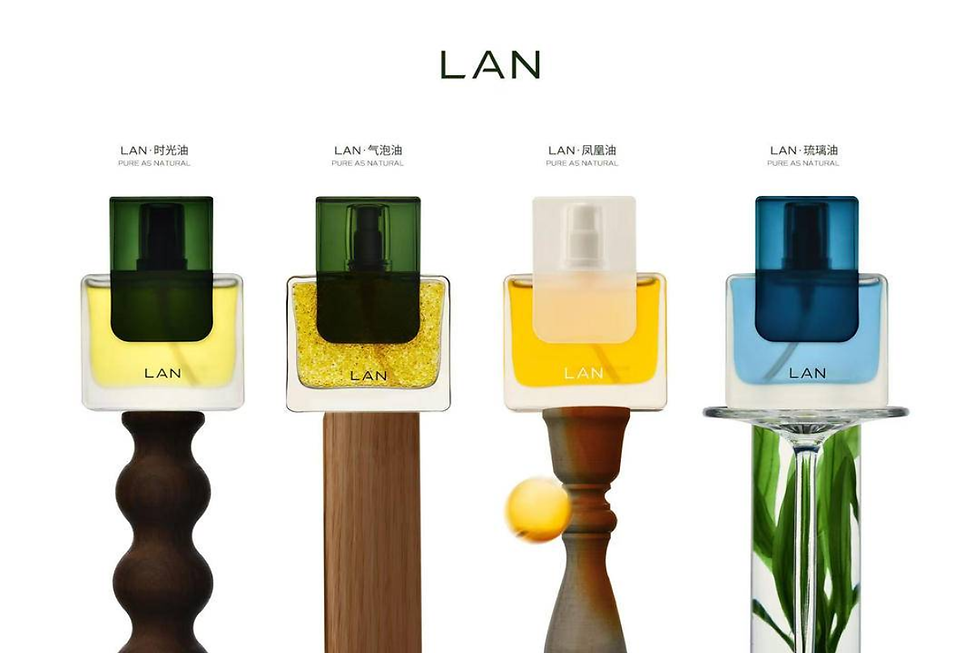
Founded in Hangzhou in 2019, LAN is best known for one thing: facial oils.
At a time when much of China’s skincare conversation revolved around acids, actives, and “功效护肤” (efficacy skincare), LAN took a different path, building its brand around “oil-based skincare” inspired by Eastern botanicals, with orchids (In Chinese, orchid is pronounced as "LAN") as its core symbolic and ingredient anchor.
This focus was not accidental. Facial oils had long existed in China, but largely as niche or imported products. LAN reframed the category for a younger domestic audience: lighter textures, clearer usage education, mid-range pricing, and a visual language that blended clean beauty aesthetics with subtle Chinese cultural cues.
The result was commercial traction in a very specific segment. According to publicly cited industry rankings, LAN ranked No.1 in China’s facial oil category for multiple consecutive years, a rare feat in an otherwise fragmented skincare market.
Crucially, LAN did not attempt to be everything at once. Instead, it:
● Anchored itself in a single hero category
● Built a repeat-purchase product structure around oils and oil-adjacent SKUs
● Positioned itself in the mass-to-mid price band, typically below RMB 200, allowing for scale rather than exclusivity
In other words, LAN behaved less like a “concept brand” and more like a category owner in the making - a trait international groups pay close attention to.

Why L’Oréal Chose LAN: Four Strategic Layers
1. A Brand Position L’Oréal Doesn’t Already Own
Despite L’Oréal’s vast portfolio, there remains a gap in its China lineup: a locally rooted, oil-centric, botanically inspired skincare brand operating at scale in the mid-market.
LAN fills that gap without directly cannibalising existing brands. It does not compete head-on with L’Oréal’s dermatological or luxury lines, nor does it replicate Western clean beauty narratives. Instead, it speaks a distinctly Chinese consumer language, one that values gentleness, balance, and daily usability over clinical maximalism.
From a portfolio logic perspective, this makes LAN additive rather than disruptive.
2. A Minority Stake Reflects Strategic Caution and Maturity
It is impossible to analyse this investment without historical context.
In the early 2000s, L’Oréal entered China’s local brand landscape primarily through outright acquisitions, including Mininurse and later Yue-Sai. While these deals were bold for their time, they also revealed the limits of direct integration: cultural dilution, brand repositioning challenges, and slower-than-expected growth.

Two decades later, L’Oréal is taking a very different approach. By investing through Meicifang and holding a minority stake, the group:
● Reduces integration risk
● Preserves founder autonomy and brand DNA
● Gains observational access to consumer behaviour and innovation speed
This is not a takeover. It is a long-term option.
3. A Vote of Confidence in China’s New Brand Generation
LAN is not an isolated case. In recent years, L’Oréal has also invested in Chinese fragrance brands such as Documents and To Summer, often alongside local consumer-focused funds. What unites these brands is not scale alone, but clarity:
● Clear category ownership
● Clear aesthetic language
● Clear consumer target
For L’Oréal, these investments signal a belief that China’s next generation of beauty brands will not simply imitate Western models, but develop their own cultural and product logic - one that global groups would rather participate in than compete against from the outside.

4. Could LAN Become an International Brand?
The question inevitably follows: Is LAN a future global brand?
The answer is nuanced.
LAN’s strengths - botanical storytelling, oil-based formulations, understated aesthetics - could resonate in markets such as Southeast Asia or parts of Europe. With L’Oréal’s regulatory expertise and supply chain support, international expansion is technically feasible. But history offers caution. Chinese brands that succeeded domestically have not always translated culturally abroad. Globalisation requires more than distribution; it requires narrative translation, regulatory endurance, and patience.
For now, L’Oréal’s minority stake suggests optionality, not inevitability.
From Acquisition to Investment: What This Tells Us About China’s Beauty Market
The LAN deal reflects a broader truth: China’s beauty market is no longer a place for simple replication or aggressive consolidation.
Instead:
● Consumer preferences fragment faster
● Cultural specificity matters more
● Brand life cycles shorten, but category leaders endure
International groups are adapting by becoming capital partners, ecosystem builders, and long-term observers, rather than immediate owners.
This shift mirrors China’s new consumption reality: promising, volatile, and still unfinished.
Looking Ahead: A 10–20 Year Story Still Unfolding
If there is one lesson from L’Oréal’s investment in LAN, it is this: China’s beauty industry is still early in its maturity curve.
Over the next decade or two, three trends are worth watching:
● The Rise of “Chinese-Language Skincare”: Not traditional medicine rebranded, but culturally rooted concepts translated through modern science.
● East-West Conceptual Fusion: Where Chinese brands lead innovation rather than follow global trends.
● Selective Globalisation: Fewer Chinese brands will go global, but those that do will do so with stronger identities and clearer propositions.
LAN may or may not become one of them. But L’Oréal’s decision to invest suggests one thing clearly: the future of beauty in China will not be built by outsiders alone.


留言